Community Impact Statement read by CTUL at the sentencing hearing in State of Minnesota v. Nelson Israel Lopez Giron (27-CR-23-7028)
CTUL (Centro de Trabajadores Unidos en la Lucha) is a 501c3 nonprofit organization that educates low-wage workers about their labor rights and develops worker-led campaigns for systemic change in low-wage industries, including multifamily residential construction. We first connected with a construction worker involved in this case after he was injured on a job a few years ago.
When working for Giron Lopez, a nail struck this worker in the eye. Giron Lopez’s response was to offer him eye drops, send him back to work, and attempt to cover the incident up from insurance, seemingly to continue frauding insurance companies.
Giron Lopez employed as many as 15 other workers, but the impact of his actions extended far beyond. Workers witnessed the treatment that the worker faced, and they learned how to expect to be treated by bosses and what protections they can expect under the legal system.
Giron Lopez worked on projects for many prominent multifamily developers in the Twin Cities, including MWF, Dominium, Enclave, Roers, Sherman Associates, and Trident Development. It seems that developers like these ones have prioritized their bottom line over human rights, allowing for labor brokers like Giron Lopez to operate with impunity.
This is not a one-off incident, but the tip of the iceberg on how the non-union construction industry functions. CTUL has seen many similar cases in our 16 years as an organization, supporting workers to recover over $6 million in stolen wages. Many workers don’t learn until after they have been injured that their employers have skirted the law that entitles injured employees to workers’ compensation. They are often not given proper safety equipment to protect them from preventable injuries in the first place. In addition to insurance fraud, misclassification and wage theft are endemic to the non-union construction industry, and workers face threats and retaliation when speaking up about these conditions. At the most extreme cases, we see cases of sexual assault and labor trafficking.
The effects on workers are devastating. There are both immediate and long-term impacts when labor brokers evade paying health insurance premiums. On the job injuries can trigger accumulation of medical debt, loss of housing, losing work, and inability to pay for basic necessities like food. In this case, the worker was left with permanent injury and long-term health struggles. When workers speak up, their employers may retaliate against them by firing or even threats on their lives and lives of their family members. The consequences of such incidents and violations ripple out to workers’ families and entire communities. When workers face a crisis, it puts a strain on community services, family members, churches, and community organizations who they turn to. Community structures do their best to support, but are not equipped to handle the overwhelming amount of incidents.
Unfortunately cases like this often do not come to public attention. When they do, it is imperative that we make crystal clear to workers, labor brokers, AND developers that this type of abuse is not acceptable. There must be swift and real consequences for those who break the law. Construction workers and labor brokers across the metro area are watching this case to see what will happen. A light sentence sends a clear message to workers that they should keep their heads low and not come forward when facing conditions like these. A light sentence also sends a message to labor brokers that it is worth risking insurance fraud, misclassification, and harming workers to increase their bottom line.
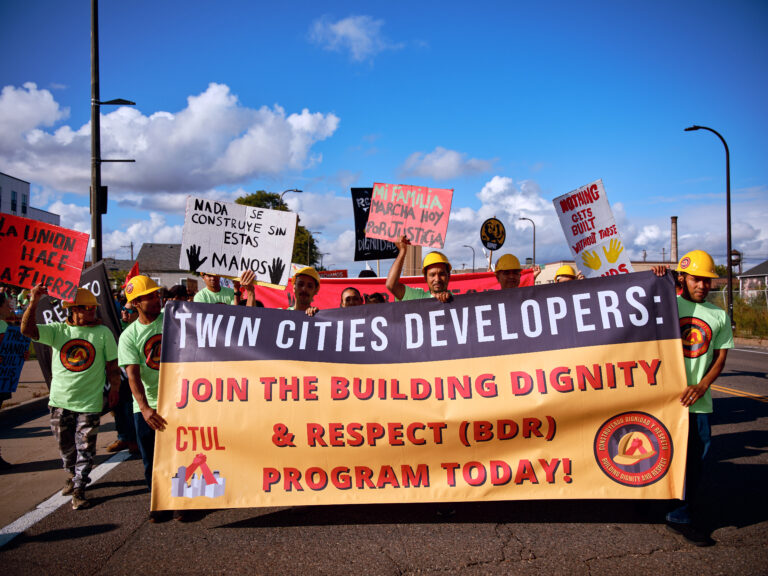
Today, we hope that the Hennepin County Court system sends a clear message to workers that they have the support of the legal system. In the long-term, we need systems change that ensures developers are accountable for the conditions on their projects, ensuring that labor brokers like Giron Lopez cannot exploit workers in the ways that have happened here. Construction workers in the Twin Cities have partnered with CTUL and other national organizations to create the Building Dignity and Respect Program (BDR) to do just that. We look forward to working with local, state and federal government to ensure that this type of abuse never happens again.